Rosicrucianism: The Invisible College
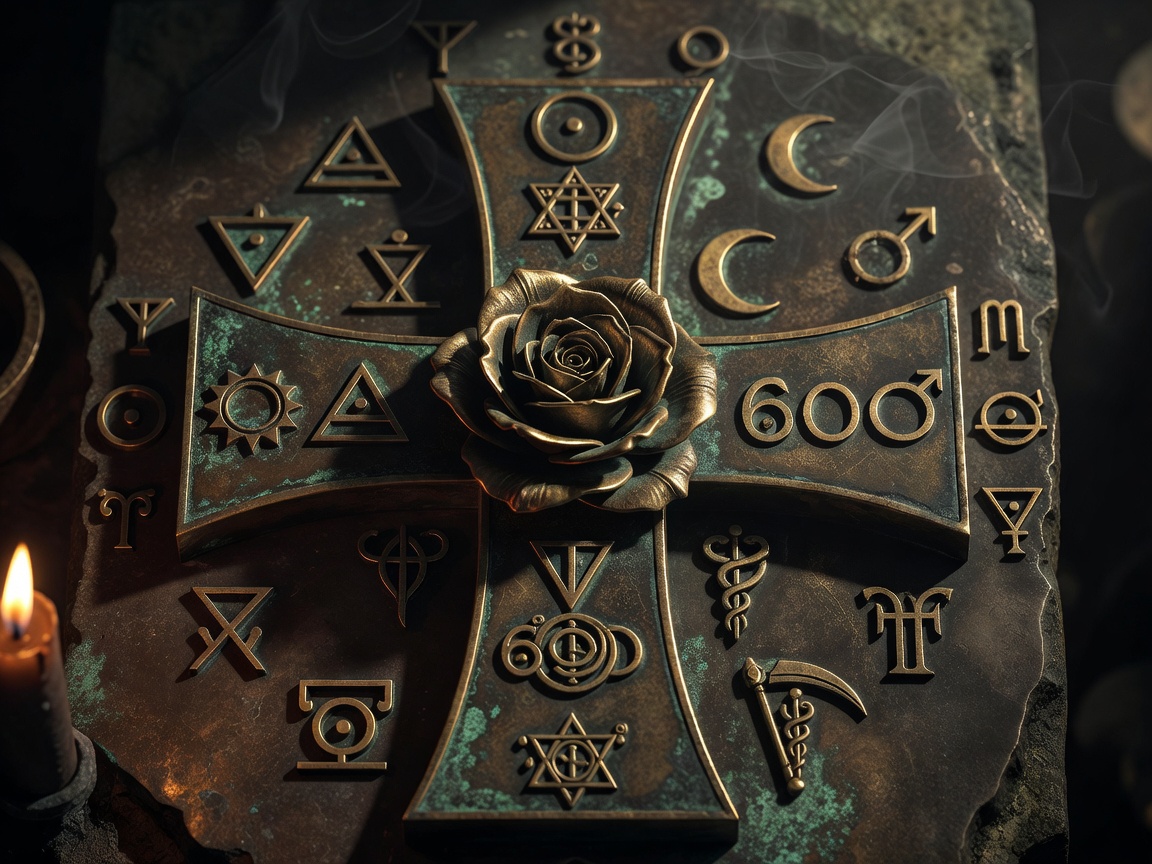
The Literary Explosion of the Manifestos
While most secret societies trace their lineage to a specific founding meeting or charter, Rosicrucianism burst into the consciousness of 17th-century Europe as a literary phenomenon. Between 1614 and 1616, three anonymous documents—the Fama Fraternitatis, the Confessio Fraternitatis, and The Chymical Wedding of Christian Rosenkreutz—were published in Germany. They caused a sensation in intellectual circles that historians now refer to as the "Rosicrucian Enlightenment."
These texts detailed the life and travels of a mythological figure named Christian Rosenkreutz, a German doctor and mystic who supposedly traveled to the Middle East and North Africa in the 15th century, gathering esoteric wisdom from Arab and hermetic masters. Upon his return, he allegedly founded the Fraternity of the Rose Cross to prepare Europe for a spiritual, intellectual, and political reformation.
Philosophy: Alchemy and Hermeticism
The philosophical foundation of Rosicrucianism is a complex syncretism of Hermeticism, Christian mysticism, Jewish Kabbalah, and alchemy. Emerging during the turmoil of the Protestant Reformation and the dawn of the Scientific Revolution, the movement proposed a "universal reformation of mankind."
Unlike modern chemistry, early alchemy was viewed by the Rosicrucians as a spiritual endeavor as much as a material one. The transmutation of base metals into gold was heavily employed as a metaphor for the transmutation of the impure human soul into a state of divine enlightenment. They rejected the dogmatic rigidity of both the Catholic Church and orthodox Protestantism, favoring a direct, experiential understanding of God and nature (gnosis).
The Invisible College and Scientific Impact
The manifestos called upon the learned men of Europe to join this "Invisible College." Intrigued scholars, philosophers, and physicians published hundreds of pamphlets requesting entry into the fraternity, though there is no historical evidence that a physical, structured order known as the Brotherhood of the Rosy Cross actually existed at that specific time. The "founders" were likely a small circle of Lutheran intellectuals at the University of Tübingen, notably Johann Valentin Andreae, who later claimed the manifestos were a ludibrium (a literary joke or serious theatrical exercise).
Regardless of their physical existence in 1614, the concept of a network of scholars sharing hidden knowledge across borders heavily influenced the development of modern science. Prominent figures like René Descartes and Gottfried Wilhelm Leibniz were fascinated by Rosicrucian ideas. The concept of the "Invisible College" was directly cited as a major influence by the founders of the Royal Society in London in 1660, demonstrating how esoteric mysticism provided the collaborative framework for empirical science.
Resurgence and Modern Orders
By the 18th century, Rosicrucianism found a physical home as its mythos was absorbed into Freemasonry. Higher Masonic degrees, particularly within the Scottish Rite (which features a "Rose Croix" degree), adopted Rosicrucian symbolism and allegories wholesale.
In the late 19th and early 20th centuries, a major occult revival led to the formation of explicitly Rosicrucian organizations. The Hermetic Order of the Golden Dawn, founded in Great Britain in 1888, drew heavily upon Rosicrucian structural models and texts. Later, organizations like the Ancient and Mystical Order Rosae Crucis (AMORC), founded by Harvey Spencer Lewis in 1915, institutionalized the philosophy into mail-order correspondence courses, democratizing esoteric study for a modern audience.
Today, Rosicrucianism remains an essential pillar of Western esotericism. It stands as a testament to the power of a compelling idea—a society so philosophically potent that it did not need to physically exist to permanently alter the spiritual landscape of Europe.